



Unlocking the Mystery of Battery Voltage: What are the Differences between 12V, 24V, and other Voltages?
This guide breaks it down clearly: the key distinction between nominal voltage and open circuit voltage, common voltages in U.S. household gadgets, cars, and EVs, why portable jump starters confuse people with amps, and real-world tips for matching voltage correctly.
In this article, we’ll cover:
- What Battery Voltage Really Means — and the Big Difference Between Nominal and Open Circuit
- Car Batteries in America: 12V Dominates, But Not All the Same
- Portable Jump Starters: Clearing Up the Amps Confusion
- EVs vs. Gas Cars: The Voltage Gap Explained
- Everyday U.S. Household Devices and Their Voltage Standards
- Practical Voltage Matching Tips
What Battery Voltage Really Means — and the Big Difference Between Nominal and Open Circuit
Voltage is the "pressure" that pushes electrical energy through a circuit — think of it as the force behind every device from your smartphone waking up to your truck cranking on a chilly Santa Clara morning. In 2026, with EVs everywhere in the Bay Area and hybrid tech advancing fast, understanding battery voltage differences isn't just geeky trivia — it's practical knowledge that saves you from dead devices, failed starts, or costly mismatches. Battery voltage comes from the chemical reaction between electrodes and electrolyte, creating an electrical potential difference. Two main types matter for everyday use:
Nominal voltage — This is the manufacturer's standard "nameplate" rating. It's the average or typical operating voltage during normal discharge. It stays fairly consistent regardless of how full the battery is, making it the go-to spec for matching devices and batteries. Examples: 1.5V for AA alkaline batteries, 3.7V for most phone lithium-ion cells, 12V for car lead-acid batteries.
Open circuit voltage (OCV) — This is the actual voltage measured across the terminals when the battery isn't connected to anything (no load, no charging). It fluctuates with state of charge (SoC). A fully rested, charged battery shows higher OCV than nominal; as it discharges, OCV drops. This makes OCV a reliable real-world indicator of remaining capacity.
Why the difference matters:
- Nominal is for compatibility — plug the wrong nominal voltage into a device, and you risk damage (too high) or no power (too low).
- OCV helps diagnose health — especially useful for troubleshooting without fancy tools.
For a standard 12V lead-acid car battery:
- Fully charged OCV: ~12.6–12.8V
- Nominal (average during use): 12V
- Needs charging if below ~12.4V
- Risk of permanent damage if consistently below ~10.8–11V
For lithium-ion (like in phones): Nominal 3.7V, fully charged ~4.2V, discharge cutoff ~3.0V.
This distinction is huge in the real world: when buying replacements, always match nominal. When checking if a battery is still good (say, before a road trip), measure OCV with a multimeter for a more accurate picture than trusting a dashboard light.
Car Batteries in America: 12V Dominates, But Not All the Same
Most gas and diesel vehicles in the U.S. stick to 12V lead-acid for starting, lights, and accessories:
Passenger cars, trucks like Ford F-150, Toyota Camry — 12V nominal. Resting OCV 12.6–12.7V full; cranks down to 10–11V during start; charging system (alternator) holds 13.5–14.7V running.
Cold Cranking Amps (CCA) matter hugely in colder areas — aim for 600+ CCA in northern states for reliable starts below freezing.
Heavy-duty rigs (semi trucks like Kenworth) use 24V (two 12V in series) for bigger diesel engines and power-hungry accessories.
EVs add complexity: They keep a small 12V (or now often 12.8–16V lithium) battery for accessories, lights, and wake-up functions — just like gas cars. But the propulsion comes from the high-voltage pack.
Portable Jump Starters: Clearing Up the Amps Confusion
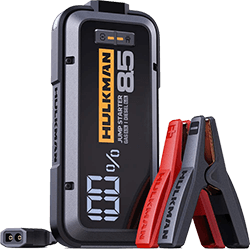
Portable car jump starters (especially lithium ones) spark endless debate because of how ratings work:
Traditional lead-acid batteries/jumpers emphasize CCA (Cold Cranking Amps at 0°F/-18°C) — critical in cold weather where chemical reactions slow.
Lithium jump starters shine with peak amps (instant max burst) and better cold performance — they often hold 80%+ output at -20°C, unlike lead-acid.
For a Ford F-150 or similar V8 truck: A lithium unit rated 800–1000+ peak amps usually handles it fine, even in cooler Bay Area winters or trips north. No need to obsess over CCA equivalence — focus on peak rating matching your engine size (800A+ for most pickups/SUVs). Lithium models are lighter, more compact, and recharge via USB-C — huge win for everyday carry in Santa Clara traffic.
EVs vs. Gas Cars: The Voltage Gap Explained
The core difference boils down to purpose:
Gas/diesel cars: 12V lead-acid focuses on short, massive current bursts for cranking the starter motor. Capacity in Ah (amp-hours), life 3–5 years.
EVs (Tesla Model 3, Ford Mustang Mach-E, Rivian): Main pack 350–400V nominal (some like Porsche Taycan or newer models push 800V+). Lithium-ion (NMC or LFP cells), capacity in kWh (e.g., Model 3 ~57–82 kWh depending on variant). Designed for sustained high power to motors, with 8–10+ year warranties.
Higher voltage reduces current (and heat/losses) for the same power, enables faster charging, and supports longer range. Tesla's packs hover around 350–400V nominal, with full-charge voltages pushing ~399–420V depending on cell chemistry.
Everyday U.S. Household Devices and Their Voltage Standards
American homes run on 120V AC wall power (often called 110V), but batteries handle the portable/low-power stuff:
- Small gadgets: TV remotes, garage door openers, wireless mice — usually 2–3 × 1.5V AA/AAA alkaline batteries (total 3.0–4.5V).
- Smart speakers like Amazon Echo Dot or Google Nest — built-in 3.7V lithium-ion rechargeable.
- Cordless vacuums (Dyson, Shark) — often 14.4V to 21.6V lithium packs for balance of power and runtime.
- Power tools (Bosch, DeWalt) — 18V or 20V lithium-ion systems (nominal per cell 3.6–3.7V, packs in series).
- Emergency backups (UPS for routers/modems) — typically 12V lead-acid batteries, sometimes in series for higher voltage.
Pro tip: For devices picky about voltage drop (smart locks, wireless sensors), alkaline batteries sag quickly below 1.35V — switch to lithium primary (1.5–1.7V) or rechargeable Ni-MH (1.2V nominal) for steadier performance. Avoid over-volting; exceeding specs can fry electronics.
Practical Voltage Matching Tips
- Always match nominal voltage first — wrong spec = fried device or no-start.
- Use OCV for quick health checks (multimeter is cheap insurance).
- For cars: Match group size, CCA to climate (higher for colder areas).
- EVs: Leave high-voltage work to pros — never DIY the main pack.
- Avoid deep discharge: Lithium below 3.0V per cell or lead-acid below 10.8V risks permanent damage.
- Chargers: Use ones matched to chemistry (e.g., don't force-lead chargers on lithium).
Voltage isn't random — it's engineered for efficiency, safety, and purpose. Get it right, and your gear lasts longer and performs better.
Ever had a voltage mismatch horror story — like a wrong charger killing a gadget or a weak battery stranding you? Share in the comments — real experiences help everyone!
Really well-explained breakdown of nominal vs open circuit voltage — this is exactly the kind of information car owners need before buying a replacement battery. The point about checking OCV with a multimeter rather than relying on dashboard warnings alone is something we always recommend to our customers in Auckland.
We also see a lot of confusion around hybrid vehicles where owners assume the 12V accessory battery is the same as the main drive battery — your section on EVs vs gas cars explains that distinction perfectly.
One thing we’d add from our experience: in warmer climates like New Zealand, CCA requirements are lower than northern US states, but heat actually shortens battery lifespan faster than cold does — so regular OCV checks matter just as much here. Great resource for anyone trying to understand their battery before it lets them down!
Unlocking the Mystery of Battery Voltage: What are the Differences bet – Hulkman Direct
jwqogigj http://www.ggx6041v4jlz6t6jx0cshq278513uh77s.org/
ajwqogigj
[url=http://www.ggx6041v4jlz6t6jx0cshq278513uh77s.org/]ujwqogigj[/url]